You cannot stand in tomorrow
You cannot stand in tomorrow. Only in yesterday, looking forward. Again. And again. Each fold a small truth, each test fold strictly after its training.
A backtest answers a counterfactual: if this strategy had been deployed at time \(t\), knowing only what was available then, how would it have performed? The standard tool is cross-validation. The default machine-learning approach — random k-fold — fails silently on time series. Walk-forward is the correction.
Why naive k-fold is wrong
Standard k-fold cross-validation shuffles the dataset, splits into \(k\) folds, trains on \(k-1\) folds, tests on the held-out fold. The procedure assumes iid data.
Financial time series are not iid. Two failure modes:
- Temporal leakage. Shuffled k-fold places training data from after the test fold's wall-clock time into the training set. A model trained in this configuration has access to future information.
- Regime mixing. Markets alternate between regimes. Randomly sampling across regimes in both training and test folds causes the model to learn a regime-average rather than a regime-specific response.
A k-fold Sharpe on a trading strategy can be twice the live-trading Sharpe on the same signal. The difference is temporal leakage, presented as out-of-sample evidence.
The walk-forward procedure
Walk-forward respects time order. At each step:
- Train on data from the start through time \(t\) (or from \(t - \text{window}\) through \(t\)).
- Test on data from \(t\) to \(t + h\).
- Advance \(t\) by a stride and repeat.
Pictorially, with initial_train = 10, test_horizon = 3, stride = 3, comparing the two train-window variants:
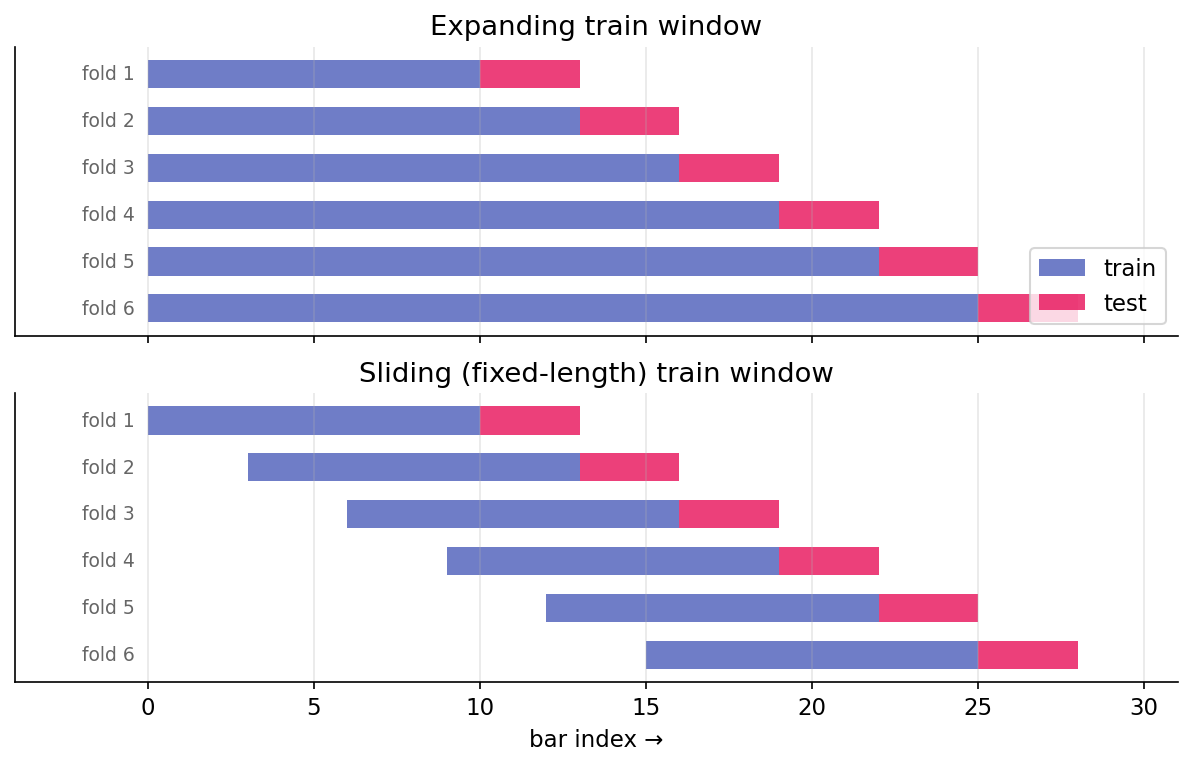
Every test fold is strictly after its training fold. No temporal leakage. Each test observation answers: what would this model have said about this period, given only what was available before it?
Expanding versus sliding
Two common variations:
- Expanding: train window grows with each step. More data; old regimes accumulate weight.
- Sliding: train window has fixed length \(W\). Adaptive to regime changes; less data per step.
For a strategy whose edge is stationary, expanding wins. For a regime-dependent edge, sliding. When unclear, run both.
Stride and overlap
The stride controls how far the anchor advances between folds. Stride equal to test horizon (\(s = h\)) produces non-overlapping test folds — simplest, most defensible. Stride less than horizon produces overlapping test folds; these appear to add observations but do not yield independent ones.
Walk-forward as outer loop
Walk-forward is the outer evaluation loop. Inside each fold, model selection may require its own cross-validation.
A standard protocol:
- Walk-forward defines the outer train-test splits.
- Within each outer train set, purged k-fold selects hyperparameters.
- Retrain on the full outer train set using the selected hyperparameters.
- Evaluate on the outer test fold.
- Advance the walk-forward anchor.
Violating this structure — using the outer test fold to select hyperparameters — introduces subtle look-ahead that will not survive in live trading.
What walk-forward does not prevent
Walk-forward catches temporal leakage but leaves other biases unaddressed:
- Label-horizon leakage. A training label at time \(t\) that depends on prices through \(t + 5\) can overlap the test fold even when \(t\) itself is in the train set. Purging (next lesson) is the correction.
- Data-snooping bias. Walk-forward evaluates a single strategy. If 100 were tried and this one selected, the test performance is biased by selection. Walk-forward does not track \(N\). Deflated Sharpe is the correction.
- Forward-looking features. Features computed from future data leak regardless of cross-validation scheme.
- Survivorship bias. Running a backtest on today's index constituents excludes companies that went bust.
Walk-forward is necessary but not sufficient. It catches the most common leakage — temporal — but not the subtler forms.
Expanding-train estimator noise
Expanding-train walk-forward produces small training sets in early folds. Fold 1 may have 252 observations; fold 20 may have 1,512. Early-fold model quality is worse not because the strategy has no edge, but because the estimator is noisy.
This biases the cumulative out-of-sample Sharpe downward in early folds. As training data grows, bias diminishes. Realized backtest performance improves over time even when the edge is stationary.
Do not mistake this for a strengthening edge. It is the estimator becoming less noisy.
Summary
- Random k-fold cross-validation produces optimistic Sharpes on time series because shuffling grants training data access to the future.
- Expanding and sliding train windows are appropriate under different conditions: stationary edge versus regime-dependent edge.
- Walk-forward catches temporal leakage but not survivorship bias, data snooping, or forward-looking features.
Implemented at
trading/packages/harness/src/harness/backtest.py:
- Line 22:
WalkForwardConfig(initial_train, test_horizon, stride, expanding=True). - Line 40:
WalkForward.split(n_samples)— generator yielding(train_idx, test_idx)pairs.
The module docstring is explicit: WalkForward does NOT execute the strategy — it yields index pairs. The caller trains, predicts, and computes PnL per window. This separation keeps the harness agnostic to model type, feature construction, and cost modeling.
You cannot stand in tomorrow. Only in yesterday, looking forward. Again. Next: what a label reaches for, without meaning to.